Higher Education Research
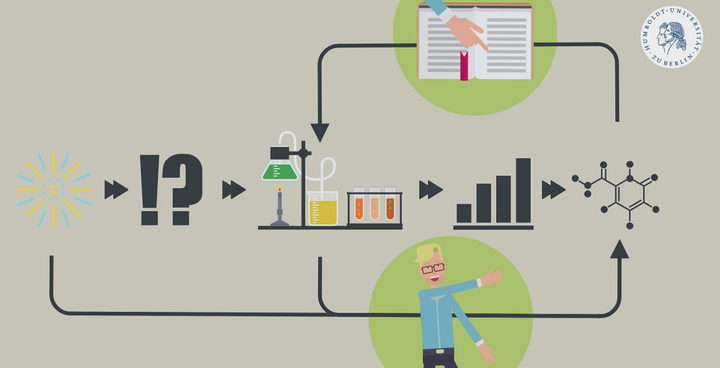 Explainer Video on Scientific Reasoning
Evaluating the chemistry teacher student education
Laying the foundation for future intervention studies on improving first phase teacher education
High-quality learning opportunities are of great importance for the development of the individual and our society as a whole. While the quality of informal learning opportunities is difficult to control, the training of teachers is considered an important factor in ensuring high-quality formal learning opportunities. In addition to affective personality traits such as teaching motivation and teaching beliefs, professional knowledge – as a superordinate cognitive trait – is attributed a strong influence on the quality of teaching.
During the first phase of teacher training at German universities, students are primarily offered pedagogical, content and pedagogical-content knowledge and methodological competences in learning opportunities (in addition to first hands-on experiences as a teacher during the internship semester). Knowledge domains can further be divided into three areas: declarative, conditional and procedural. While the latter are attributed a higher influence on teacher’s actions in the classroom, declarative knowledge has a more indirect effect through lesson planning. However, initial study results show that the practical knowledge of teachers does not increase during their training (nor with experience), but rather declarative knowledge is accumulated.
In this project, both the affective and cognitive traits of students are measured in a longitudinal study design and differences in trait distributions between the courses are used to generate hypotheses about underlying processes and to make claims on what should be tackled in teacher education. At the same time, a baseline will be set that can be used as a reference in subsequent intervention studies. The instruments to be used get thinned out and the evaluation of future measurement points automated.
Simon Schäfer
Visiting Researcher
My research interests include higher education and Bayesian statistics.